
The new AI-LERT indicator from Coface and the Observatory for Threatened and Emerging Jobs (OEM) highlights a growing decline in job vacancies in the occupations most at risk from artificial intelligence in France. Far from being limited to entry-level roles, this phenomenon also affects positions requiring several years’ experience.
Key figures
- In the third quarter of 2026, an additional ten percentage points of exposure to AI is associated with a 12.4% lower growth in job vacancies – since the launch of ChatGPT – compared with roles less exposed to AI within the same sector. This gap applies equally to roles requiring little experience and those requiring several years’ experience.
- Between 20 and 35% lower than expected:jobs in sales, accounting and management, human resources, IT, consultancy and research, law and R&D are significantly below their expected levels given the recruitment trends in their respective sectors.
- Over 100,000 job vacancies missing per year: this is the estimated shortfall in vacancies across these occupational groups compared with the number expected based on sectoral trends.
- Similar findings in Germany and Sweden: the available data reveal a comparable shortfall, affecting the same broad occupational groups. In the third quarter of 2026, an additional ten percentage points of exposure to AI is associated with a 10.8% lower growth in vacancies in Germany and 10.2% lower growth in Sweden, compared with occupations with lower exposure within the same sector.
The initial adjustments in the labor market do not necessarily take the form of redundancies: they can occur quietly when a company postpones a recruitment decision or chooses not to replace an employee who leaves.
Our findings suggest that this mechanism may already be at work in the occupations most exposed to AI, including roles requiring several years’ experience.
Whilst they do not allow us to isolate the contribution of AI, the emergence of this slowdown a few quarters after the launch of ChatGPT, its intensification since then and its gradual spread to new occupations constitute a body of evidence that is hard to ignore,
explains Aurélien Duthoit, sector economist at Coface and co-author of the study with Axelle Arquié, co-founder of the Observatory of Threatened and Emerging Jobs.
AI-LERT: an early warning system for labor demand
Having identified, in an initial study1, the occupations most at risk of automation by AI, Coface and the OEM are now turning their attention to the first signs of change in recruitment. Based on job vacancies registered with France Travail, AI-LERT compares trends in job vacancies across occupations that are more or less exposed to AI, relative to their levels in the third quarter of 2022 and the launch of ChatGPT.
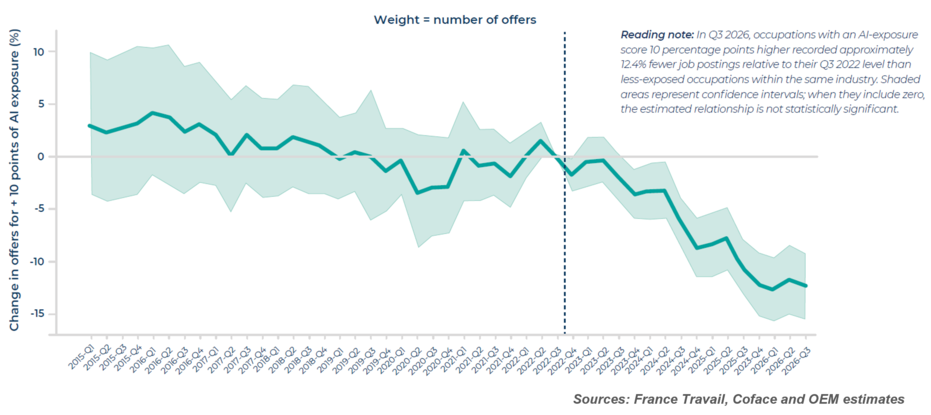
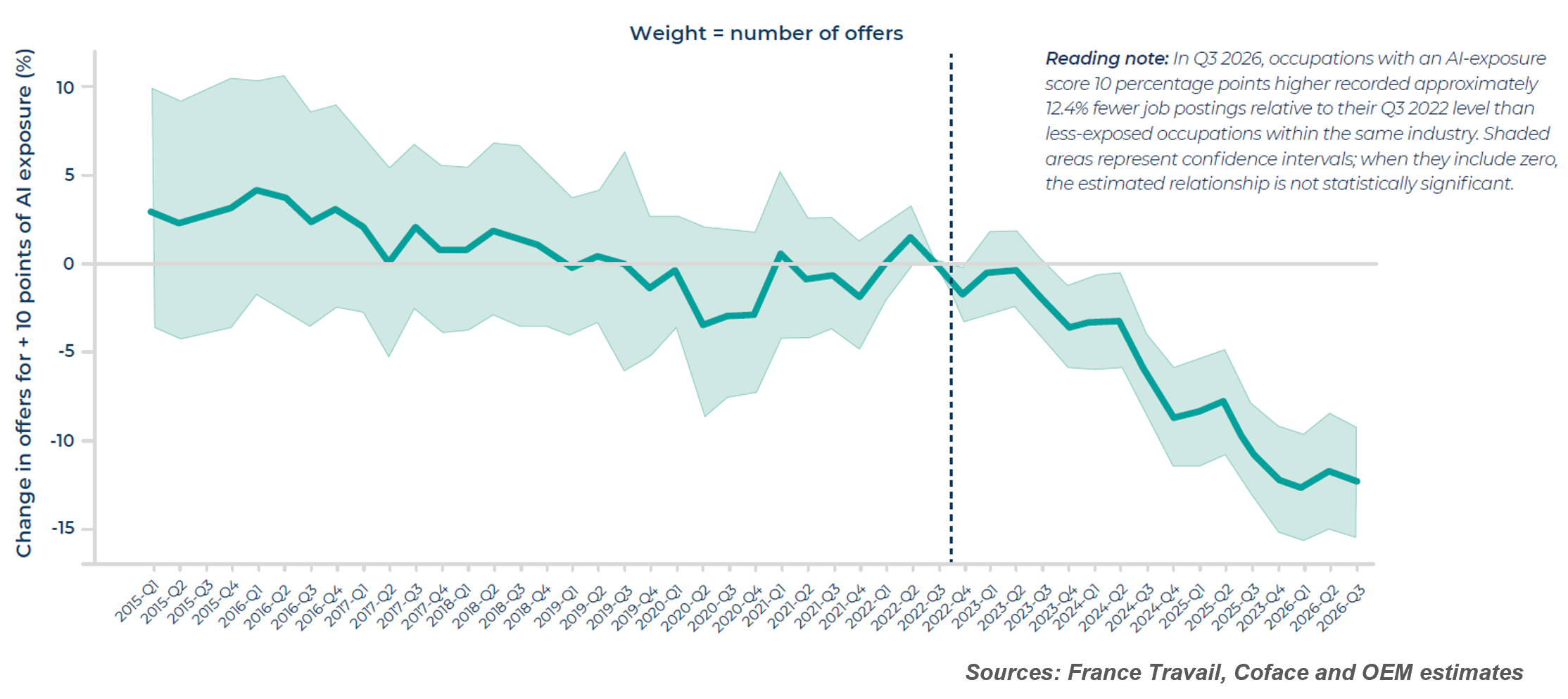
While no statistically significant relationship was observable prior to the launch of ChatGPT, a decline in job vacancies in the occupations most at risk began to emerge as early as the third quarter of 2023 and has since become more pronounced. In the third quarter of 2026, an additional ten percentage points of exposure to AI was associated with a 12.4% lower growth in job vacancies compared with occupations less exposed within the same sector, relative to their pre-ChatGPT levels. Whilst these results do not establish a direct causal link, their timing, persistence and scale suggest that AI may already be influencing companies’ recruitment decisions.
AI-LERT: difference in job vacancy trends for a 10-point higher exposure to AI (%, Q3 2022 base)
Data for graph in .xlsx format
Jobs requiring several years’ experience are also affected
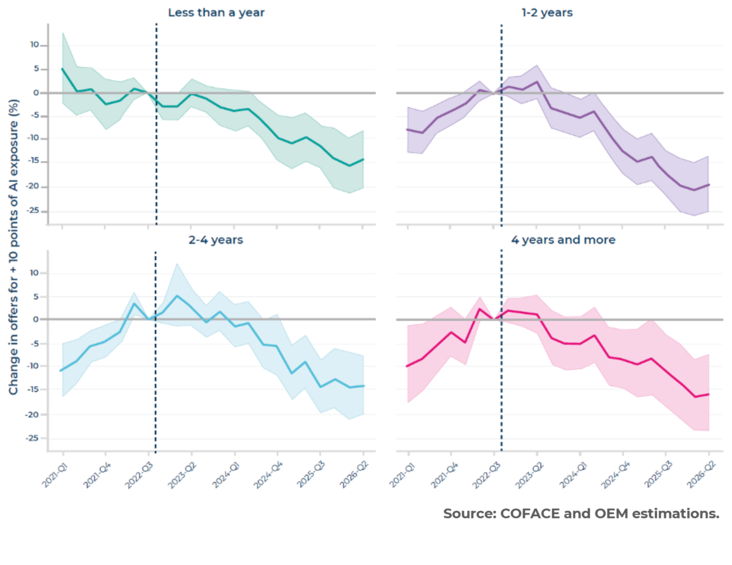
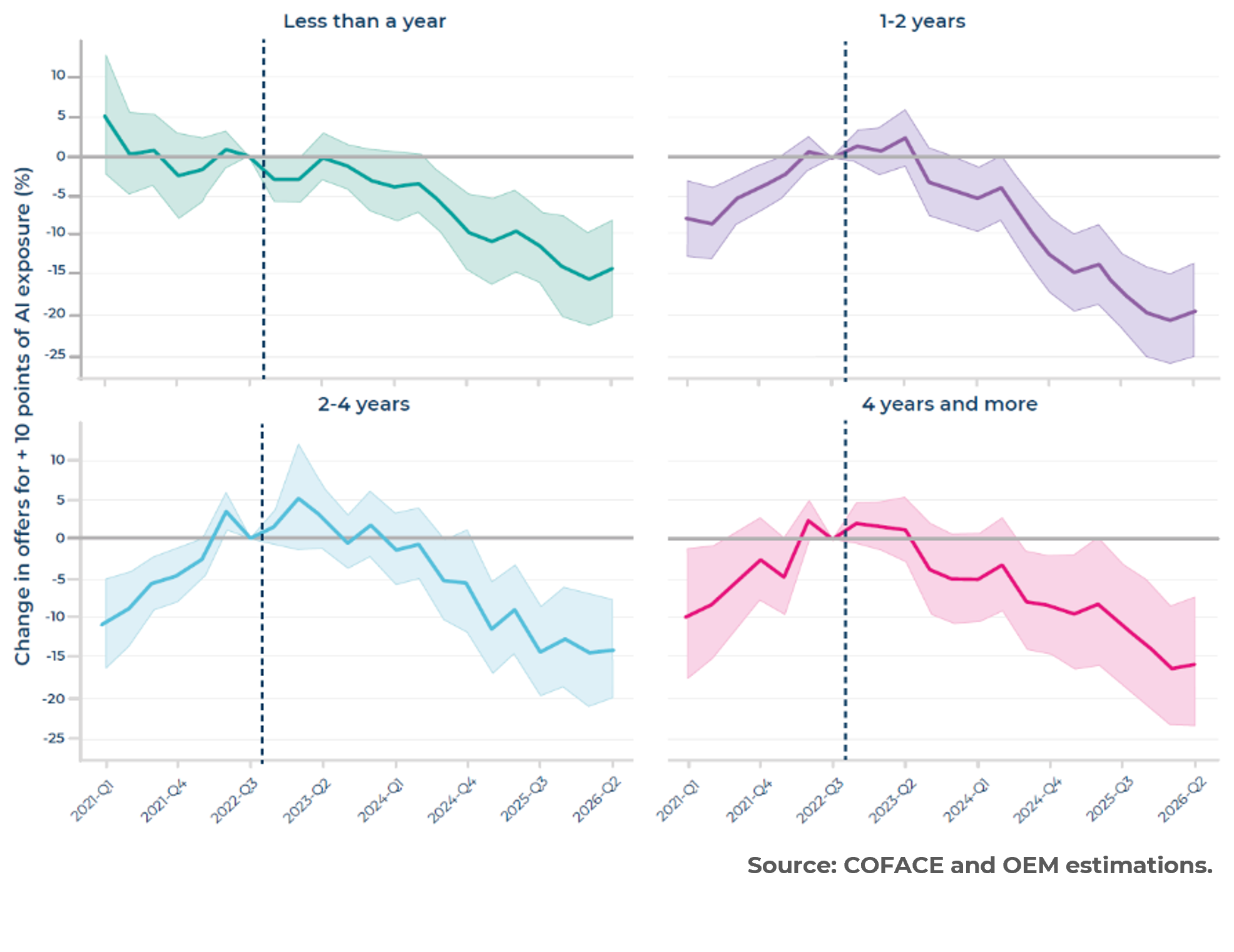
While early studies seeking to measure the impact of AI focused mainly on young workers, AI-LERT suggests that the slowdown affects all levels of experience:
–14% for roles requiring less than one year’s experience,
–19.4% for those requiring one to two years,
–14.1% for two to four years,
and –16% for more than four years.
AI-LERT differential change in job postings by required experience level (%)
Data for graph in .xlsx format
While the differences between these categories are not statistically significant, the results show that the phenomenon may not be limited to entry-level roles. Companies may not only reduce junior recruitment but also question the need to replace an employee leaving the organization, for example.
On the front line: 'white-collar’ professions
The decline in job vacancies is particularly marked, at around 20% to 30% below the levels seen in the sectors that employ them, in certain roles within sales, accountancy and management, human resources, IT, consultancy and research, law and R&D. If we annualize the decline observed in the third quarter of 2026, this represents more than 100,000 missing job vacancies in these occupational groups.
Conversely, more manual occupations, typical of the skilled trades or industry, as well as those in healthcare, security and cleaning, show no significant decline.
Germany and Sweden: converging trends
We observe this same decline in job vacancies for the occupations most exposed to AI in both Germany and Sweden, two European countries whose statistics allow us to replicate our methodology. In the third quarter of 2026, a ten-percentage-point increase in exposure to AI is associated with a 10.8% lower growth in job vacancies in Germany and a 10.2% lower growth in Sweden2. As in France, occupations in administration, accountancy, IT and sales are among those most affected. This convergence of results across such diverse economies reinforces the significance of the French example and reduces the likelihood that these findings reflect solely national peculiarities.
Towards a sustainable transformation of the labor market?
Does this slowdown in recruitment within occupations exposed to AI herald a phase of job losses, and will there be enough new jobs to offset them?
Coface and the OEM outline four possible scenarios depending on the pace and scale of job creation and destruction:
- a gradual creative destruction, where job creation and job losses would be largely synchronized and equivalent
- an abrupt creative destruction, characterized by a long period of job losses before job creation offsets the losses
- a gradual erosion, where job creation would not be sufficient to prevent a gradual decline in employment
- or finally, in the most unfavorable scenario, a purely destructive process, where rapid job losses would not be offset, even in the long term, by equivalent job creation.
No scenario is set in stone. The trajectory of the labor market will depend in particular on the future distribution of productivity gains and their potential to stimulate demand and job creation. Economic and social policies will also have a decisive role to play, both in supporting the retraining of workers, promoting the widespread distribution of productivity gains, and in supporting those who may find themselves permanently out of work. The impact of AI on employment will therefore depend as much on economic and political choices as on technological progress itself.
> Dowload the full report now.
1 From Safe to Exposed: How AI is redrawing the map of work
2 Compared with that of occupations less exposed within the same sector of activity, relative to their pre-ChatGPT levels.


